
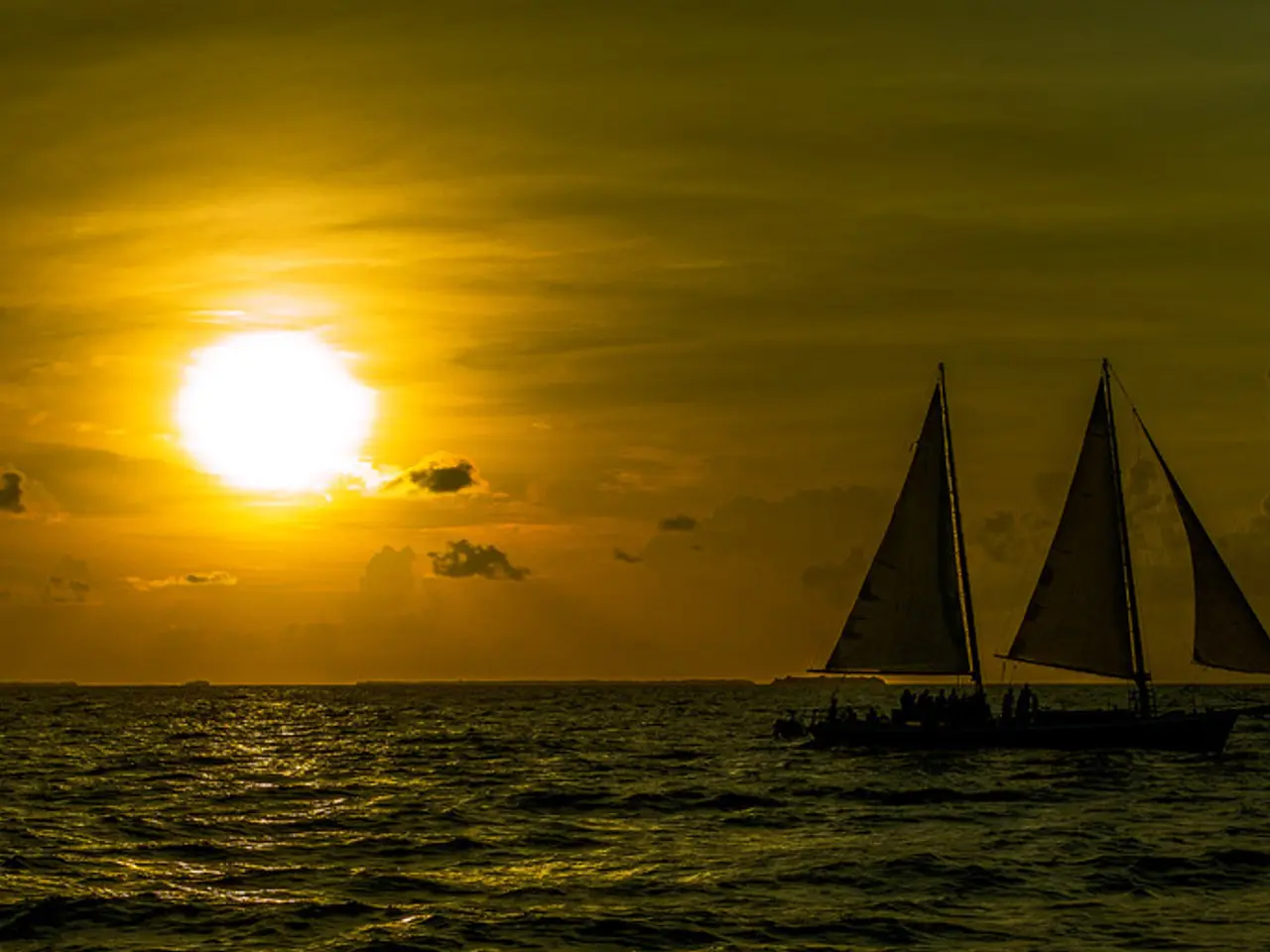
Vessel simultaneously located across distinct centuries, years, months, days, and seasons
In the late 19th century, a remarkable naval journey took place that has since been shrouded in intrigue and debate. The ship at the heart of this tale is the SS Warrimoo, a vessel whose story, while not related to the mysteries of pirate stories, race walking, or marine life ownership, has captured the imagination of many.
On October 1, 1884, forty-one delegates from 25 nations assembled in Washington D.C to establish the Prime Meridian, marking a significant moment in navigational history. This decision set the stage for the SS Warrimoo's unique voyage.
Captain John Phillips, at the helm of the SS Warrimoo, found in his old logbook a navigational coincidence that on January 1, 1900/2000, the ship was positioned at the intersection of the equator and the International Date Line (IDL), placing it simultaneously in four hemispheres, two centuries, two months, two days, and two different times.
As the bow of the SS Warrimoo sailed into the Southern Hemisphere and the middle of summer, the stern was making its way into the Northern Hemisphere and midwinter. This extraordinary positioning allowed the ship to straddle two different days, two different months, two different years, two different seasons, and two different centuries all at the same time.
However, the claim of the SS Warrimoo's century straddling was not mentioned in the initial reports about its arrival. It was not until 1942 that Captain Phillips rediscovered this navigational feat in his logs.
The IDL, caused by the decision made at the Washington Meridian Conference, has been known to cause oddities in geographical proximity. For instance, Big Diomede Island, part of Russia, is always one day ahead of Little Diomede, part of the US.
Martin Fone, a blogger and writer with a passion for investigating the quirks and oddities of life, has delved into the story of the SS Warrimoo. His latest book, More Curious Questions, explores this and many other fascinating tales.
Yet, when the century straddling element is stripped away, the SS Warrimoo's story loses some of its sheen. Regardless, it remains a testament to the extraordinary feats possible with precise navigation and a touch of luck.
The common scientific and historic consensus is that a century consists of 100 years and that the first century of the Christian Era ran from 1 to 100, the second century from 101 and so on. However, the SS Warrimoo's voyage challenges this notion, offering a glimpse into a navigational oddity that has captivated the imagination for over a century.
Despite the debate surrounding the SS Warrimoo's century straddling, its story remains a fascinating chapter in the annals of maritime history. Whether or not the ship truly straddled centuries, it undoubtedly performed a rare nautical feat that would have knocked golden and even emerald shellbackery into a cocked hat.
Read also:
- Harsh Desert Environments Support Thriving Fruit Groves: Agriculture in Severe Climates
- One night of sleep deprivation can cause changes in our genes, according to a research study.
- Reporting on Measles Vaccination among Mennonite Community
- Governmental personnel records to no longer include COVID-19 vaccine statutes of employees